
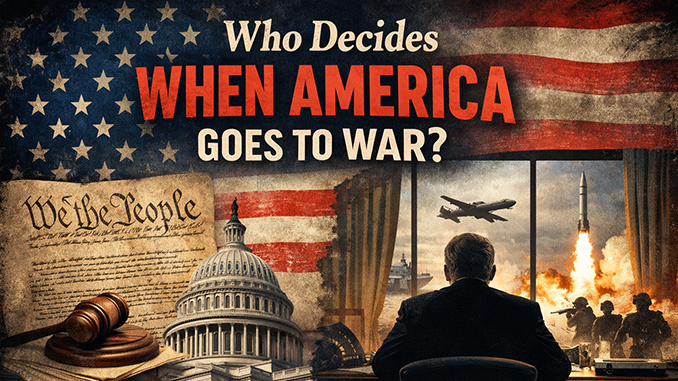
Set aside whether you believe we should use military force against Iran or not. That is not the point of this article. Rather, let’s explore the more important question…who decides when America goes to war?
Why This Matters in a Constitutional Republic
Okay, say what you will about President George W. Bush and him leading us into the Iraq war, but comparing his actions with President Trump’s actions in attacking Iran is very useful and instructive. One of these Presidents followed the Constitution, as well as international law, prior to using military force, while the other made a unilateral (one might even say “authoritarian-type”) decision, bypassing the Constitution and the international community.
Making the Case vs. Skipping the Case Entirely
No matter what you think about the Iraq war and how Bush got us into it, the facts remain that he spent about a year making the case for military action in Iraq before he did it. He argued his case to the American people, to the U.S. Congress, to our international allies, and directly to the United Nations.
The results of his persuasion were such that by the time we first attacked Iraq:
- 70% of the American people supported it
- Congress voted to authorize the military action by huge supermajorities in both the House and the Senate
- He had formed a coalition of allies consisting of 45 nations around the world who would support our efforts either directly on the battlefield or indirectly in other strategic and logistical ways
- He had sought and received authorization through a United Nations resolution
Compare that to President Trump’s efforts leading up to his attack on Iran:
- Polling in January of 2026 indicated that around 70% of the American people opposed attacking Iran. He never attempted to inform or persuade the American people that it was the right thing to do. He just didn’t bother with that.
- He never attempted to persuade the U.S. Congress to authorize or support the military force, defying the constitutional demands for it
- He has not only not attempted to form any type of coalition of nations to help with the military effort, but he has also disparaged and alienated our longtime allies during the past year so much that very few of them would ever trust him to lead such an operation
- Of course, he doesn’t really believe in the United Nations at all, so he didn’t bother with them (I mean, he disrespects that organization of nations so much that he just sent his wife, who has absolutely zero qualification or authority, to preside over the United Nations Security Council).
This Isn’t About Relitigating Iraq
Now, we could get bogged down in a debate about whether Bush lied to everyone in order to convince us to attack Iraq, but there is a lot of nuance, interpretation, and subjective opinion involved when looking at issues where he may have chosen to go with the worst-case scenarios in conflicting intelligence, or exaggerated certain facts, or outright lied about intelligence. However, all of the counterarguments to what Bush was saying were out there for the world and Congress to see and consider during the debates…and in the end, the American people, both in the form of polling and in their representation in Congress, and the world at large, were overwhelmingly on board. Yes, in retrospect and hindsight, most of us can agree that the Iraq War cost us more than it was worth, but after the events on 9/11, the American people and most of the rest of the world were in no mood to give Saddam Hussein the benefit of the doubt, so while the blame for Iraq is mostly laid on Bush, I hardly think that is a fair analysis of what happened.
But that’s not what the point of this article is about.
The Core Point: War Cannot Be the Decision of One Man
The point I’m trying to get across is that in our democratically elected constitutional republic, we follow the laws and the Constitution…and when it comes to matters such as using military force, it’s of the utmost importance that we don’t allow these decisions to be made unilaterally, by a single man. That power in one person would be near the epitome of what it is to be an authoritarian.
But that is exactly what Trump has done, with the complicity of a Secretary of Defense who just directly told our troops that, “We will finish this on America First conditions of President Trump’s choosing, nobody else’s. As it should be.”
No, that is absolutely NOT “as it should be”.
What the Constitution Says About War Powers
The U.S. Constitution explicitly gives the power to go to war with another nation to the Legislative Branch. This was, by design, a specific limit placed on the President in such a manner to demonstrate that the President is NOT a King who can send its citizens to fight and die in wars that are created merely on the King’s whims. It placed that power in the hands of the branch of government that is closest to the People…the Legislative Branch, which is the direct representation of the People. So, the idea was that it would be the People (as represented by their elected Congressmembers) who will decide when and where to risk themselves in war. The days of authoritarian dictates by a King on such matters were over…and for damn good reason as should be obvious to any rationally thinking person.
The Article II Excuse and Why It’s Bullshit
But now we are in a situation where Presidents from both parties have acted against the Constitutional authorities and have unilaterally deployed military forces, claiming that their Article II powers (designating them as Commander in Chief) allow it. This is bullshit, and has been bullshit from all of the Presidents who have claimed it from both parties. It’s very telling that when a President does this from either party, the opposite party’s Congressmembers raise holy hell complaining about how that President doesn’t have the authority to do so, but then they support it when a President of their own party does it. The problem is with Congress completely abdicating its authority on the matter for partisan, political reasons.
To be clear, the Constitution does not give the President ANY authority to unilaterally use military force. The only relevant part in Article II (which describes the powers of the Executive Branch, aka the President), is Section 2, which specifically states:
“The President shall be Commander in Chief of the Army and Navy of the United States, and of the Militia of the several States, when called into the actual Service of the United States.”
That’s it. It says only that the President will command the military when it is called into actual service (meaning that when Congress declares war, the President will then command it). There is NOTHING that gives the President any power to go to war or use the military in any way unilaterally.
The War Powers Act and the Three Conditions
Congress actually did try to remedy this issue with the War Powers Act of 1973. This legislation actually provided more power to the President than the Constitution does. It allows for the President to use military action only under three specific circumstances:
“The constitutional powers of the President as Commander-in-Chief to introduce United States Armed Forces into hostilities are exercised only pursuant to: (1) a declaration of war, (2) specific statutory authorization, or (3) a national emergency created by attack upon the United States, its territories or possessions, or its armed forces.”
Trump’s attack on Iran fails all three conditions.
It is very clear that Trump has no such authority to act on his own like he has with Iran (or Venezuela, or Ecuador, or anywhere else he has been using the military).
The Real Failure: Congress Abdicating Its Duty
The problem, again, is with Congress. Congress passed the War Powers Act in 1973 precisely to protect their own Constitutional powers. The President at the time (Nixon) didn’t like this new law, seeing it as restricting him from his own perceived powers as President to command the military so he vetoed that bill. Congress then overrode that veto with a 2/3 majority vote in both the House and the Senate, which is very rare and damn near impossible in today’s divisive, partisan environment. But ever since then, Presidents from both parties have essentially ignored the restrictions of that law (and the Constitution) and have used the military at their own whims and Congress has done nothing to stop them. In reality, this lack of enforcing their own laws has meant that Congress has abdicated its duties and they are failing to uphold the laws and the Constitution that we have empowered and entrusted them to do.
Unfortunately, the Senate just did it again today…they failed to enforce their own law and protect their own Constitutional powers by voting against a bill that is designed to stop Trump from acting unilaterally. This breaks their oath to uphold the Constitution, abdicates the people’s power to decide such matters, and allows more authoritarian power to the President. It’s shameful on so many levels.
What This Power Turns a President Into
This allows the President to pretty much do whatever he wants. A president who has such power is more akin to an authoritarian than to an executive that is bound to limits of power given to him by the people. He is literally saying he can do whatever he wants, while sending us off to war at his whim. He literally says that his power is only bound by his own morality. And if that doesn’t concern you, you are not thinking clearly.
The Point Trump’s Supporters Keep Missing
Lastly, I keep seeing Trump supporters posting stuff that is providing reasons why we should support Trump and his use the military against Iran for all of the horrible things they have done not only to their own people, but also to Americans over the last several decades. While all of that is true, it is completely missing the point. Debating those issues are precisely what should happen with the people and specifically in Congress PRIOR to any military use. Personally, I’m probably more sympathetic to the idea of taking out brutal regimes around the world, who are responsible for the brutality of millions, than most others…but only after a very thorough analysis of it with very clear plans and goals, and buy-in from the people, congress, and our allies. As we’ve experienced with Iraq, even with massive support, the results of such actions can be devastatingly terrible. But going it alone, in an obviously whimful manner with constantly changing stated objectives, with no support from the people or the world at large, has the potential of having much worse results.
